A recent 2026 survey of 19,000 people between 18-35 across 36 European countries showed something quite shocking: around two-thirds of them have positive sentiment towards China and are in favour of closer EU-China economic ties. One could blame TikTok, a Chinese company (only its US arm was divested), for tweaking their algorithm to essentially brainwash the European youth into a more agreeable worldview to this oppressive dictatorship, but perhaps that’s too narrow a view. Certainly, one shouldn’t discount this theory entirely, but the shift from the much more conservative older generations that still view China largely with suspicion may come from something much more basic, and far less nefarious: finances.
China relies heavily on manufacturing, primarily to employ and entertain its own people, but all the cheap knickknacks that don’t get absorbed by its vast population are instead shipped overseas, flooding markets and undercutting domestic productions. Although services now represent a majority of Chinese GDP, it must continue its massive industrial output to sustain its 6%+ YoY growth and produce more, and more, and more.
Young people use sites like SHEIN and Temu to shop as cheaply as possible, which is not surprising considering the state of the economy for the youth in particular. Supplement this with images online of futuristic cities bathed in neon and advanced drone shows in the skies, and you’ll end up having a rather positive view, even though the products are far below average in quality and the neon cities are falling apart from the inside.
Although this sentiment is not reflected in the majority or in older generations, it seeps into politics, nonetheless. It is not from the younger generation’s lobbying – they are too small a voting bloc – rather, much of the free world has been left with no choice. President Trump, with his at best confusing policies and at worst hostile rhetoric, has pushed his allies away and into the arms of China.
Canadian Prime Minister Carney, for example, struck a deal with China on EVs over culturally aligned America across the border, not because he believes China is a superior trading partner to the US, but because he simply had no other choice. The choice then is not whether China or the US are better partners, but between the devil you know and the devil you don’t.
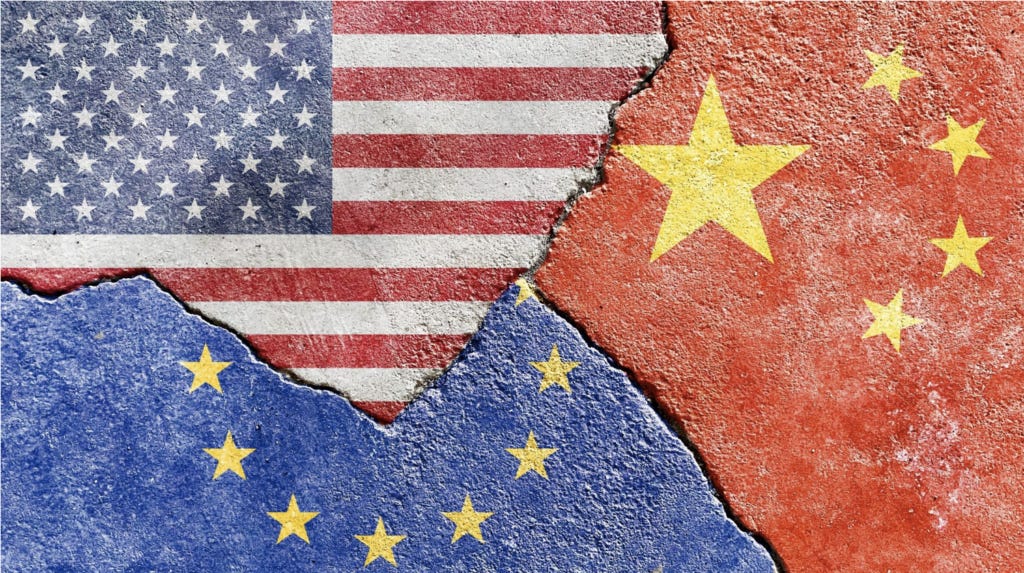
The Devil You Don’t
While America’s recent actions may make China seem like a more reliable trading partner today, this is a trap. China is in a somewhat similar position as Russia was before their occupation of Crimea (and truthfully, for a few years after) in the eyes of the public. Europe foolishly believed they could trade their way to lasting peace with Russia, based on the notion that Putin was somewhat like a Bond villain: calculating, cold, untouchable, but ultimately rational. He would never invade Ukraine proper, that would spell the end of the Russian economy, which is surely as reliant on European trade as Europe is on Russian trade! Well, the rest is history so to speak.
Following such a disastrous miscalculation, this image of his has taken a bit of a hit. Now, Chairman Xi Jinping has taken his role. Cold, calculating, untouchable, but ultimately considered rational. He would never invade Taiwan; it would spell the end for the Chinese economy which is surely as reliant on global trade as global trade is on China!
Now, China is eyeing Taiwan. While history doesn’t repeat, it certainly rhymes. Today, China stands for around 20% of European goods imports, making them a key trading partner. Europe relies on China for 80-90% of their solar panels, batteries and industry-critical rare earth elements (or so-called REEs).
Particularly concerning is the notion that their control over REEs could be wielded against Europe like Russia once wielded gas and oil, but with even more devastating effects. Some industries would quite literally screech to a halt without the REEs China processes. Although there have been EU efforts to diversify the supply chain and Sweden has recently discovered a big lithium deposit, China still dominates the market as, frankly, they have by far the most scale of any REE producer in the world. China is also, coincidentally, eyeing a smaller neighbour.
The Devil You Do
Publicly, the EU has distanced itself from China. The trade deficits are worryingly unequal, the domestic market is being suffocated by cheap goods, and the Taiwan situation has caused concern for well over a decade now. China also heavily protects and subsidizes its own domestic market, and has a long history of stealing European intellectual property whenever EU companies attempt to sell there. The EU’s so-called “trade bazooka,” floated by some during the Greenland saga, was initially created to deter China from trying to coerce individual members of the EU and a derisking of Chinese-dependent supply chains is underway.
Yet, if you zoom in a little closer, the numbers tell a different story. China recently passed the US as Germany’s top trade partner, while several Central and Eastern European countries have seen Chinese shares of their imports rise over the past few years, 7.5% YoY (but 20% in Hungary). Most of Europe still relies on Chinese solar panels, since their own industries couldn’t produce solar cells at competitive prices. From 2018 to 2023, Europe increased its reliance on China for manufactured goods, despite diversification.
It would certainly seem to some that Europe may be repeating the same mistake. The EU had plenty of opportunity to phase out its reliance on cheap, Russian energy following the Crimean occupation of 2014. The sanctions the EU placed then, which seemed significant at the time, was not enough to deter Russia from trying their luck again. Neither will this “derisking,” which attempts diversification but still sees China as the main supplier.
At the same time, the US is politically volatile, yes, but still a democracy. It has the deepest capital markets and largest economy in the world. More critically, Europe and the US have a shared history, and with some increasingly-visible exceptions, common values. In three years, which today seems like an eternity, someone else will take his place. It would do Europe well to stick with the devil they know at the end of the day. Europe must continue to deepen its capital markets and build up its own defence so as not to be reliant on the US, but it must surely be seen as a preferred partner to China.
In the interest of fairness, it should be noted that relying on cheap, manufactured Chinese goods is very different from relying on cheap energy. In many areas, a competitor could easily take China’s place, with the notable exception of REEs. Simply looking at import numbers and percentages doesn’t paint the entire story either. In Germany’s case, for example, much of what they import from China is transformed and then exported somewhere else for a higher value, making the two of them more like different stops along the same supply chain than dependent partners.
However, the point still stands: China is not a safer trade partner than the US. Twice in one decade, Europe has tasted the cost of its dependencies, once from Russia and once from the US. If China invades Taiwan, is Europe ready to handle a third?