NATO has certainly had quite the journey over the past three decades. Once one of the most powerful alliances the world has ever seen, it became virtually brain-dead without an enemy in the USSR, only to spring back to life when Russia invaded Ukraine and even expanded its borders. Now, it seems the parties involved have signed the paperwork and are awaiting the divorce decree. This dramatic line comes not from opinion, but from the fact that European leaders have apparently been drawing up credible contingency plans to continue NATO without the U.S., which has long been the spine of the alliance.
This comes on the back of a shaky first year together with the new President Trump, who has made it clear he sees his allies as liabilities at best and moochers at worst. In response, NATO allies committed to higher spending and Europeans have shouldered the full burden of supporting Ukraine. Then, as many know, President Trump credibly threatened Greenland earlier this year. His threats have ramped up since allies refused to assist in the Iranian conflict, despite NATO being a purely defensive alliance and having told them he does not need nor want their assistance several times (the messaging is… mixed, to say at the least).
In my recent career as a writer, I have written about the possibility of a European military several times. The conclusion is that it would be incredibly difficult to pull off. However, if the U.S. leaves and Europe (as well as Canada and Turkey) take charge, it could be the closest thing to making that idea a reality. However, like all things, this depends on what these plans are.
So, let’s dive in!
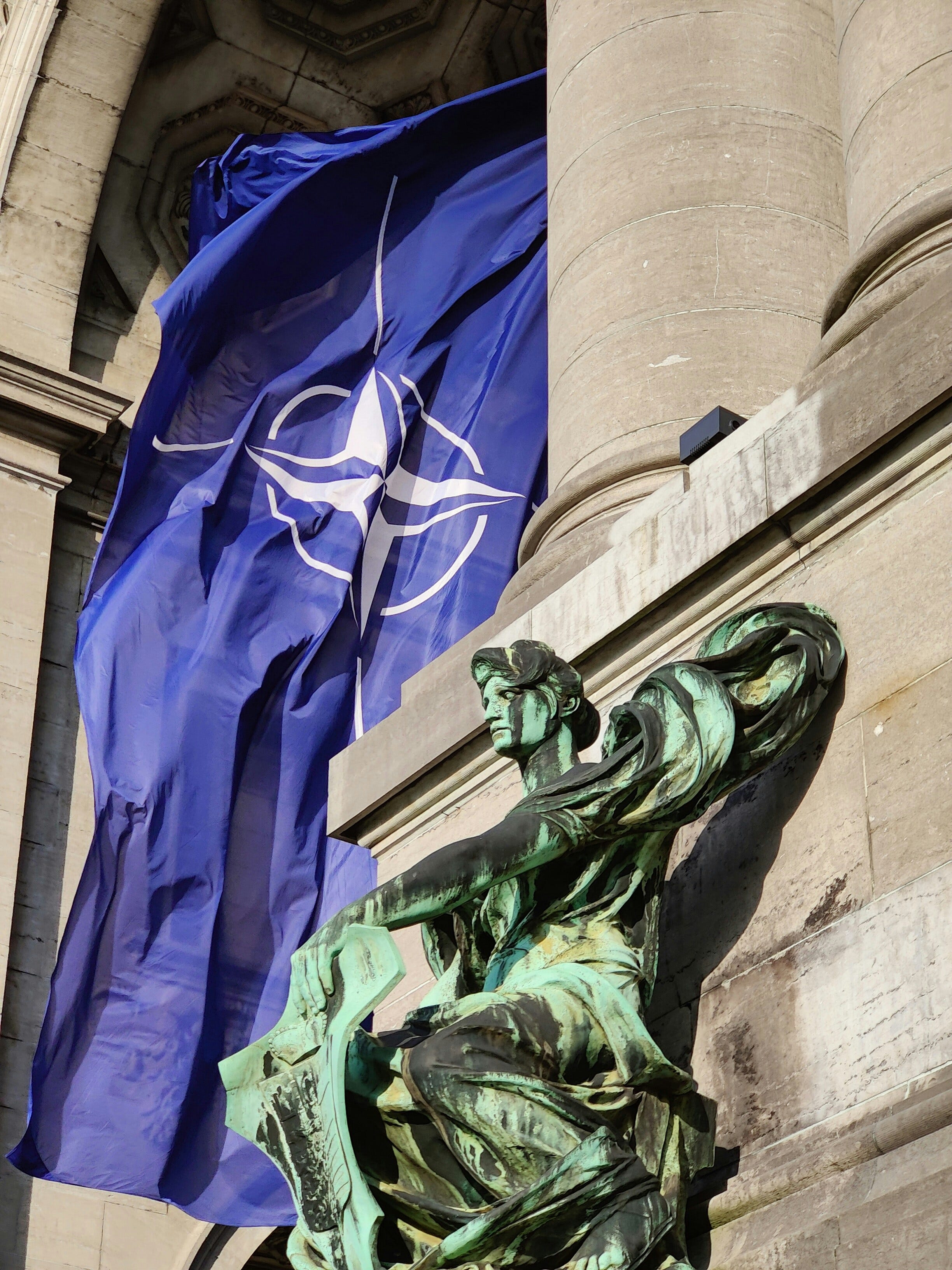
The Plans
At the time of this writing, there are no official sources on what these plans could look like. Most of the planning, if there is any, is happening through informal backchannels, and the reporting relies on leaks to the Wall Street Journal and secondhand reporting. Although the president has explicitly threatened pulling the U.S. out of NATO, he is nothing if not reliably unreliable. Leaders are likely waiting to see if this is just bluster, and whatever plans have been drafted are probably loose.
This is probably wise, as President Trump has made several threats he hasn’t followed through on. As an example, he has threatened to pull troops out of Europe before, which has not happened. Even during this conflict, he has threatened to shift troops around from “unfriendly” (like Spain) to “friendlier” countries (like Hungary and Poland). He has not followed through on this. Furthermore, the next president could be open to returning to NATO, so some room must be left for that possibility.
Either way, as there are no official sources regarding these plans as of yet, some of this will be speculation. It is based on existing NATO architecture and how that could interface with current European capabilities, but speculation nonetheless.
Europe is likely to shift key positions of leadership, which are predominantly American, to Europeans, Canadians, or even Turkish command, while supplementing the gaps the U.S. leaves behind with European production. This has the highest likelihood of a smooth transition by leveraging existing infrastructure. While there are some gaps in capabilities which the rest of NATO cannot supplement, particularly nuclear weapons, Europe does outpace America in artillery, tanks, and infantry fighting vehicles, largely thanks to contributions toward Ukraine. American jets are still far superior, but against Russia (the likeliest aggressor), European jets will still be more than adequate.
Another gap is that of intelligence. Europe relies on American intel, which could be in jeopardy if the president becomes irate enough to pull out of NATO. To address this, the Netherlands has suggested a European “Five Eyes” concept, which would be heavily reliant on the border regions to Russia (that is Poland, the Baltics, and the Nordics, further deepening the accelerating integration of the region). For those who are unaware, the Five Eyes is an intelligence-sharing community consisting of the U.S., UK, Canada, Australia, and New Zealand.
The one problem that remains mostly unsolvable is nuclear deterrence. Although both France and the UK possess nuclear weapons, it is no match against the 5,460 that Russia maintains. In the worst-case scenario, no one could blame France and the UK for reserving their comparatively meager arsenals for themselves. This raises risks of nuclear proliferation in Europe, although that still seems like a very distant risk considering President Trump will be leaving office for good in just three years.
What It Means for Us
What would make this plan work over an independent European military is, of course, that the architecture is already there. Although Europe is very fragmented across different weapon systems, cultures, and languages, NATO still works efficiently. However, the key is, of course, that Europe’s strategy relies on lasting long enough for the U.S. to mobilize and come to its aid, not necessarily integrating and working together. As such, a European NATO would be Europe’s biggest challenge yet, but not as big as building a whole new military from scratch. How this new NATO would be led is another question, but to prevent squabbling among the members in Europe, it may be best to anoint Canada, as it can give unique perspectives and does not come with the baggage that Germany or France would.
However, make no mistake, this is only a solution for the desperate. Even if we find solutions to the gap in nuclear capabilities and intelligence, NATO would still be severely diminished without the U.S. Even now, the U.S. accounts for roughly two-thirds of the combined defense budgets of all NATO members, as well as providing critical support in the form of airlifting, air-to-air refueling, offensive and defensive cybersecurity, and air defense. Europe is working hard to catch up but would need at the very least one more decade (but possibly two) in order to plug these gaps.
On the American side, things would not look so rosy either. While Europe certainly relies on the U.S. for its intelligence, it is much more of a two-way street than one would initially assume and would be a considerable hit to its own ability to track threats. The divorce would also leave considerable space for China to definitively become the world’s financial powerhouse, considering how tariffs have already damaged the trade relations that have made the U.S. the most powerful country on earth. They would also likely lose their European bases, significantly damaging their ability to project power (especially toward the Middle East, which has just proved how important a node it is to global trade). In many ways, it would be like handing over the keys of the kingdom—for both sides.
While people and leaders on both sides would rather scornfully denigrate the other currently, everyone would do well to remember that the U.S. and Europe are much more powerful together. What made NATO so special for so long was how the U.S., despite its far more powerful position, treated its allies as equals even when Europe fell far behind. The reason BRICS isn’t nearly as influential, despite its financial goals having much lower thresholds for success than a full-blown military alliance, is that it’s a collection of countries that all like to imagine themselves as the alpha, and they treat each other as such. In the chatter about Europe’s weakness, we forget that the U.S. needs Europe too.
The generations that remember a time before this alliance have died, and so we have forgotten the most important thing of all: Europe and the U.S. are far stronger together than we ever will be apart.