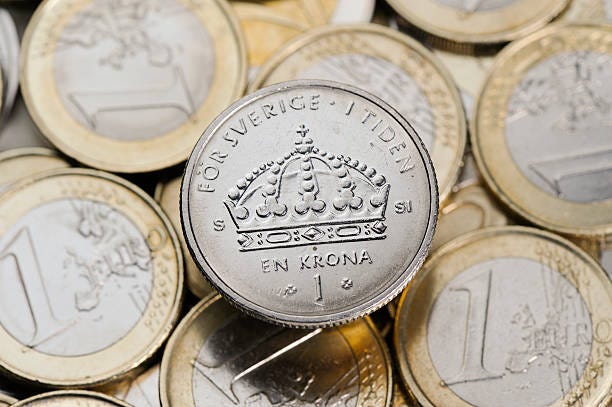
The EU and its role in the world have been a hotly debated topic over the past few years, particularly now as tensions remain high over Greenland. Whenever security becomes uncertain, it’s natural for smaller countries to seek larger partnerships to anchor onto and one of the available options for the Nordics is to seek deeper integration with the EU. Naturally, whenever deeper integration is back on the map, the debate on adopting the euro pops up again. Over the last month, the Swedish government has given some timid indications of once more considering joining the euro, requesting a formal investigation into the matter. Sweden already had a referendum on the matter back in 2003, soon after joining the EU, where the “no” side won with 56% of the vote, and the krona lived on. Since then, the referendum has been treated as legally binding by the political establishment and the debate has all but simmered out.
Now, as the EU is increasingly being positioned as a burgeoning superpower, it could be the time to reexamine the possibility of Sweden joining the euro, with Denmark perhaps following. This article will examine both the opportunities and negatives that could come with this move.
The Negatives
To begin with, a loss of autonomy is impossible to avoid if Sweden joins the euro, which is the biggest criticism. The euro, like the krona, is of course managed by their respective central banks – a useful tool for managing different economic conditions. Should Sweden adopt the euro, they lose a tool to unilaterally manage asymmetric economic shocks. For example, a banking crisis concentrated on Nordic or Swedish lenders could hit harder in the euro, because the European Central Bank can’t just consider Swedish interests, it must also manage German and French situations. With the Krona, Riksbanken (the Swedish Central Bank) could easily allow the Krona to slide to cushion exports or tailor liquidity to suit the banking needs of the country. In the euro, if inflation is high in other countries, the ECB may have to remain firm on their rates, which limits the levers the Swedes can pull. Furthermore, Sweden is a small country reliant on exports and deliberately leverages its weak currency in order to remain competitive on the global market. It should be noted though that Sweden already shadows ECB policy very closely, so its de facto monetary independence today is small.
Another fear harkens back to 2008, when the euro was struggling. Sweden managed to soften the blow of the 2008 financial crisis thanks to Riksbanken’s rigorous policy, and so the fear is that Sweden may be dragged into crisis due to the financial mismanagement in other eurozone countries. High public debt elsewhere in the euro area raises fears that Sweden might be drawn into future bailouts or fiscal backstops it cannot fully control. On top of this, studies suggest that Sweden has not underperformed due to not adopting the euro as compared to Finland, which did adopt the euro. This can be partly attributed to clever monetary policy helping boost GDP, which enabled a speedy recovery post-2008. There have been studies into whether Sweden would have done even better by adopting the euro, rather than simply avoiding underperformance outside the eurozone, but most analyses find the difference to be negligible either way. Then, the question is, why fix what ain’t broke?
The Positives
Well, just because it ain’t broke, doesn’t mean it can’t be improved. While the biggest drawbacks are of an economic nature, it follows then that the biggest advantages are also economic. As mentioned above, Sweden already shadows the ECB so closely that it has already constrained its flexibility, even if it has preserved its independence. By adopting the euro, Sweden loses more autonomy, but they also gain influence by being able to affect policy directly. Just like Norway, as an outsider to the EU, is still beholden to its laws as part of the common market, but without the right to vote on them, Swedish economic policy is currently impacted by ECB decisions they have no say in. Joining the euro would put Sweden inside the room where key monetary and financial decisions are made, increasing influence over rules that already shape its economy. Furthermore, by eliminating the risk of krona-to-euro exchange rate, Sweden will not just deepen trade within the EU, but also potentially attract investment that would otherwise deem the krona as too risky. Firms and households would face reduced currency conversion costs, and Swedish companies could borrow and price more easily in a large, liquid euro capital market.
Politically, one could see the risk of deepening divides within the right. The Swedish liberals and centre-right express some support of joining the euro, as do the left. The hurdle would likely be the Swedish Democrats, which could become the biggest party on the right in the next election. Domestically, it may become a hot-button issue, but geopolitically it aligns with recent Swedish trends of deepening cooperation with others, after having joined both NATO and the Coalition of the Willing.
At its core, the euro debate in Sweden is no longer the ideological question it once was. In 2003, the referendum took place in a world where the EU was primarily an economic project, NATO enlargement was distant, and war was something that happened to others. Today, the context is radically different. Currency policy is no longer just about inflation targeting and export competitiveness; it is increasingly tied to security and political leverage. No one could blame Sweden if they join the euro, nor if they choose to stay out. What’s important is to not let nostalgia or fear rule this decision, but to approach it with facts in hand.