It’s hard to believe it has only been a year since President Trump returned to the presidency. Since then he has renamed the Gulf of Mexico to the Gulf of America, unleashed a trade war on seemingly the entire world, yelled at Ukraine’s President Volodymyr Zelenskyy in the Oval Office, attempted to broker peace between Russia and Ukraine, kidnapped a sitting (albeit illegitimate) President in Venezuela, sent troops into American cities – all of that, on top of pissing off his closest allies. However, this week, which marked one year since his inauguration, may have been his worst yet (at least geopolitically). The Board of Peace, where he has installed himself as Chairman for life, has been snubbed by key allies and seems destined to be composed of autocrats and dictators, not the alternative to the UN he seems to have envisioned. Then, after a surprisingly muscular response from the EU, he backed on both his tariffs and the threats of military action vis-à-vis Greenland without anything substantial to show for it. Furthermore, there was finally a meeting between Ukraine, Russia and the US yesterday – but thanks to further Russian stonewalling, it resulted in very little. Frankly, if the operation in Venezuela represented how far the President’s reach can stretch, this week shows the limitations of his power.
What’s more interesting than European gloating though, is how this all came to be. Just a week ago, he seemed unstoppable, capable of imposing his will on anyone and anything. Perhaps this comes partially from an expectation that the EU would bend over backwards to reach a deal with the President, like they had when they negotiated the trade deal earlier in 2025 at great cost to themselves both financially and politically. What the EU’s actions show is that there is a way to defeat Teflon Don, but only if you have a stomach for risk. This article will dissect how to win a trade war against the Trump administration, using the EU and China as examples – but first, we must understand the underlying factors that shaped the psychology of the leaders that made this happen.
The Backdrop
The first week of the new year, President Trump was riding high on the huge operational success of the abduction of President Maduro from Venezuela, with very little bloodshed and minimal spillage into the surrounding region, on top of taking control of Venezuelan oil. However, at home, his popularity has been steadily declining – particularly in the two subjects where he usually enjoys fairly stable numbers, namely immigration and the economy. The economy in particular haunts the midterms like a ghost, as only 32% of Americans believe they’re in a better financial position since the President took office. One indicator of this is the embattled Obamacare subsidies which passed the House on the 8th of January, thanks to 17 Republicans joining their Democratic colleagues (although the President has stated he might veto them even if they pass the Senate). While Trump is sitting in his last term, other Republicans will be concerned about how the state of the economy may affect their chances in the upcoming midterms, as shown by this bipartisan bill, and so it will still be on the President’s mind.
That being said, the President used his momentum to immediately start demanding ownership of Greenland, regardless of what Greenlanders themselves want. His true motives remain somewhat unclear, but he had shown through Venezuela that he was willing to use force to achieve his goals and could thus use that leverage in negotiations with the EU.
That was when he overplayed his hand.
At first, Europe responded only with strong rebukes and upset feelings. When the President then began threatening further tariffs on certain members of the EU, in spite of the deal he himself had agreed to in 2025, Europe responded by pausing the ratification of the trade deal and dusting off an old sanctions package, as well as loading the so-called “trade-bazooka” for the worst-case scenario. Although firing it may hurt Europe more than it would hurt the US, the additional selloffs of the treasury bonds and the drop on the stock exchange may have spooked him, harkening back to the anxieties surrounding the health of the US economy. Furthermore, the EU has proved resilient despite the existing tariffs, which has calmed their fears — and they almost single-handedly support Ukraine now, meaning the threats of further tariffs and less support for Ukraine carry less weight than they once did. The EU has also opened up new markets with their free trade deal with Mercosur, despite protests, hedging against some of the worst effects of American tariffs. Trump has made himself so unpopular in Europe that it’s politically expedient to be seen taking tougher measures against the US, even on Europe’s far right. As he once put it to Zelenskyy, he has no cards left to play.
How to Win a Trade War
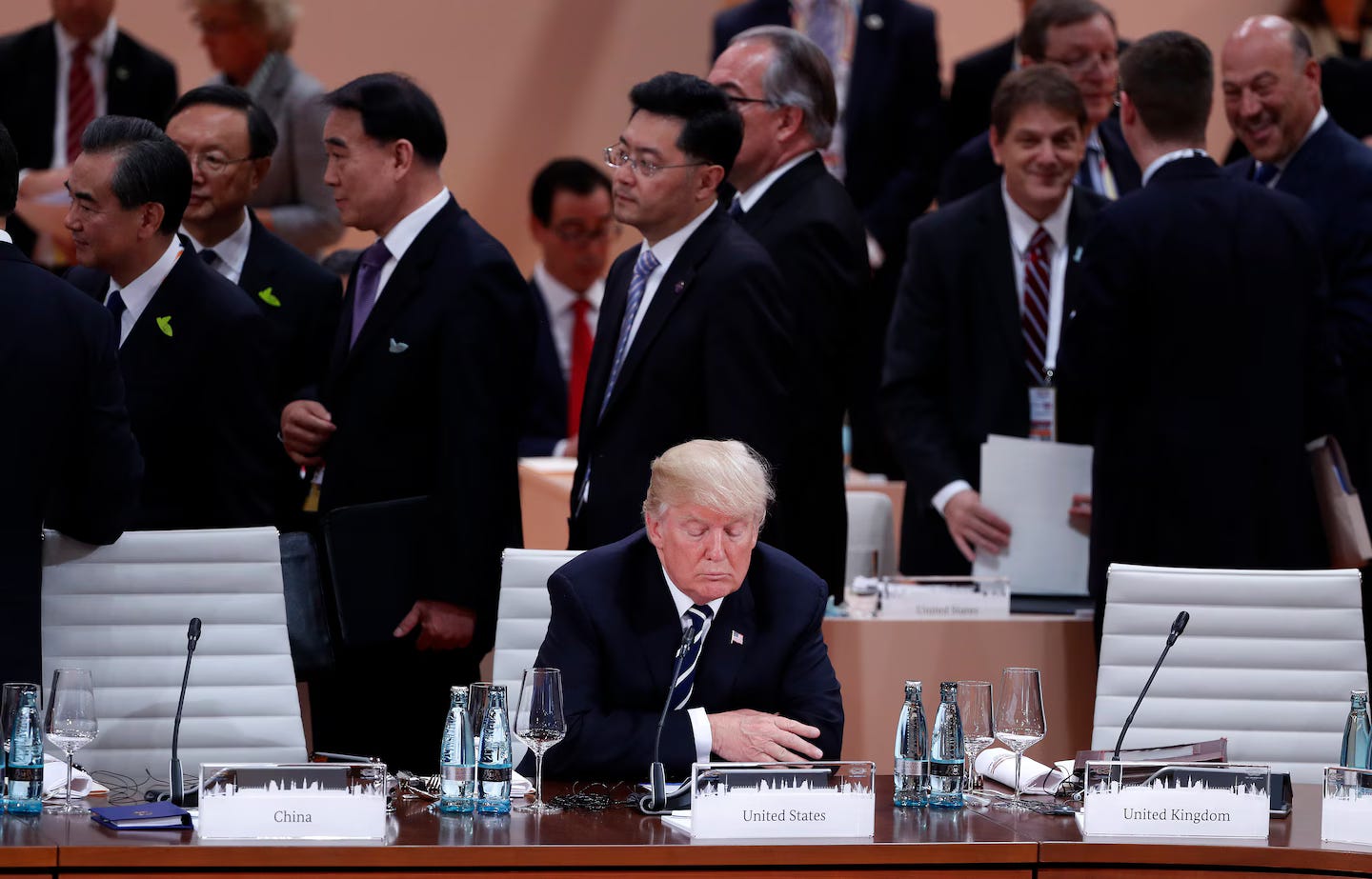
This is not the first time the President has backed down from a trade war. The first country to have tariffs imposed on them, even before liberation day, was China. At first they hovered around 20% on each other, but after liberation day it escalated into a tit-for-tat trade war which culminated in 84%-125% tariffs. However, after blowback from the agricultural sector, they eventually settled on the US’ 50% tariffs on China, and China putting 32% tariffs on the US. While not a complete success for either side, the relationship between Party Chairman Xi Jinping and president Donald Trump is significantly warmer these days, with the President calling Xi “an amazing guy.” From these two incidents, here are three easy steps you can take to win a trade war against Trump:
Stick Together: Present a united front with allies to deny Trump divide-and-conquer opportunities. The EU’s internal cohesion and informal alignment with China in 2025 prevented him from picking off weaker partners first, amplifying collective leverage.
Endure and Escalate: Absorb initial blows while preparing delayed, precise countermeasures that build domestic US pressure over time. China’s 2025 farm tariffs (on soy and pork) eroded Trump’s rural base by harvest season, forcing a June truce without major concessions. The escalation in Europe was relatively short, only about two weeks, but the question of Greenland was already rather unpopular in the US and so the domestic pressure didn’t need much of a nudge to start boiling.
Hit Him Where It Hurts: When the President targets you, it’s because he perceives you as weak or thinks he has the upper hand. It’s clear from his language that he looks down on Europe and sees their dependence on the US as something to exploit. When the EU then conceded on the trade deal last time, as well as on some sticking points in the Ukraine-Russia peace deal, he naturally believed he could get anything he wanted from them. By specifically targeting industries close to his heart, like agriculture, rare earth minerals and technology, you will soon find that his resolve is not as strong as it seems. TACO, indeed.
The best way to handle Trump, it seems, is not through concessions like the ones the EU made last year, but through brute force. This shouldn’t surprise anyone, as that is the only language he has ever spoken, even during his first term. However, while many rightfully see Trump’s words as creating a world where the law of the jungle reigns supreme, what his actions have done is prove the opposite. Only through cohesive, strong, and multilateral action can you defend yourself against this perceived bully. Trump has pushed Canada into China’s arms and forced Europe into self-sufficiency, which is a good thing for European long-term resilience, but means America stands alone. When America’s allies and foes alike have been forced to take steps away from the US, they have stepped closer to each other. What leverage do you have when no one can trust you enough to even give you a little? America is a great and dynamic country which will continue to thrive in spite of its politics, but it’s made much harder when you’re alone — the Trump administration has single-handedly undone 80 years of trust-building with friendly countries around the world, and Americans are beginning to realise that “America first” may in fact mean “America alone.” In his quest to destroy the world order, Trump seems to have proven why it exists in the first place.