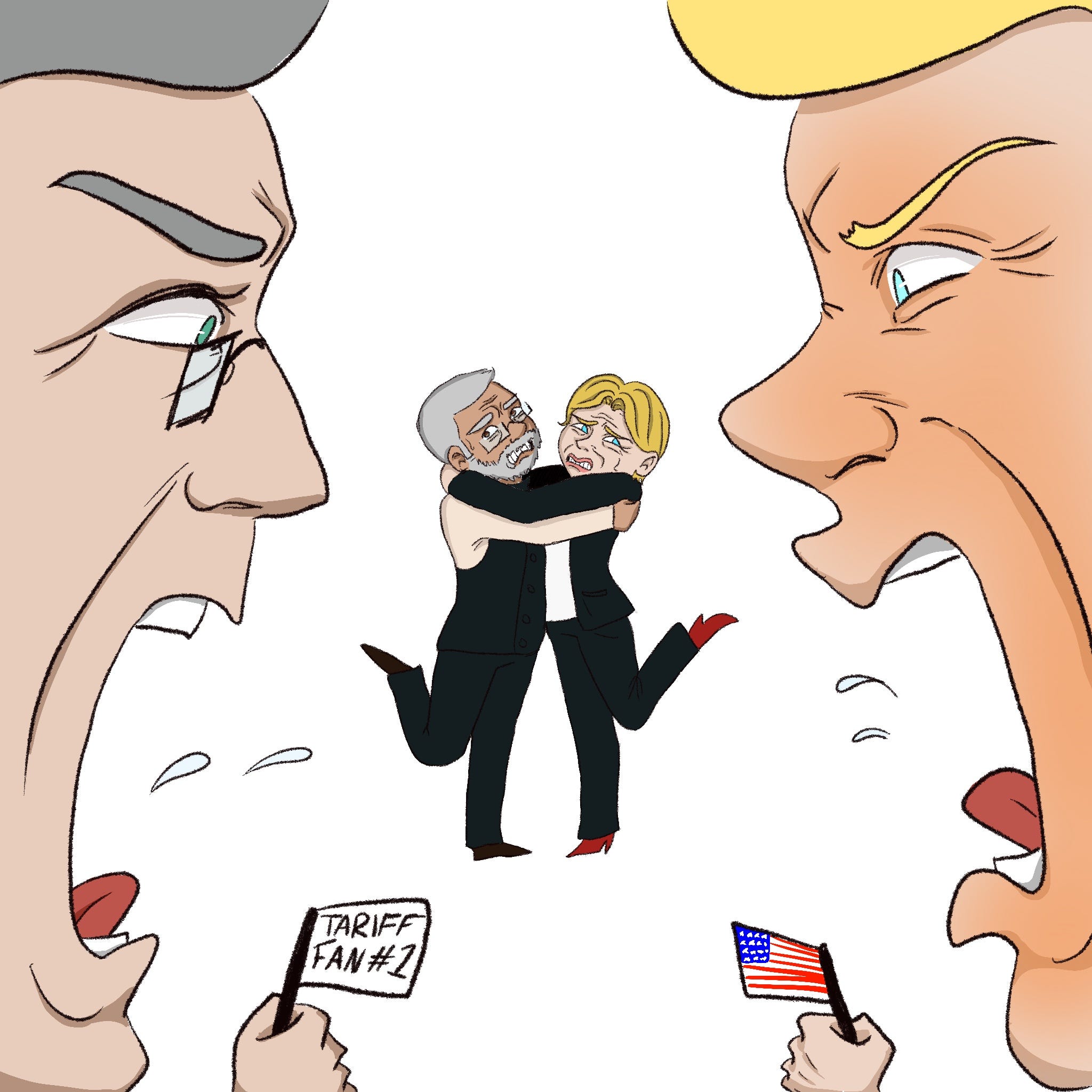
Right off the back of the historic, 20-years-in-the-making EU deal with Mercosur, Ursula von der Leyen has now delivered “the mother of all deals” with India. The negotiations of this deal began in 2007 but were stalled in 2013 due to Indian reticence towards opening up its deeply-protected car manufacturing market, while the EU was pushing for deeper commitments on services, investment protection, IP, and market access for dairy and other farm products. Neither side had been too interested in reopening talks until 2021 when they formally restarted, but the real shift happened with President Donald Trump’s second arrival on the scene. His tariff policies hit both India and the EU hard and somewhat unexpectedly, chasing them into each other’s arms. Trade between India and the EU amounts to around $136 billion, which is expected to double by 2032 on the back of this deal.
As for what the deal entails, India is set to slash 96-97% of their tariffs on European goods, while the EU will phase out their own tariffs on Indian goods over seven years by 99.5%. The headline concession is on cars, on which Indian tariffs will be reduced in stages to about 10% on imported European vehicles from historic highs of 110% (although they have introduced a quota of 250,000 vehicles per year). For the ailing European car manufacturing industry, this deal opens an entirely new market in the fastest growing economy in the world. Furthermore, India will also cut tariffs on European alcohol. On the EU side, it will assist India in its green transition in order to skirt its own requirements on environmental issues and allow increased mobility for skilled workers and students from India. Both New Delhi and Brussels frame this agreement as a success, with Europe gaining unprecedented access to one of the largest markets in the world and India receiving privileged access to one of their most important partners in trade. The question for us then, is how will this affect the Nordics? While much of this would seem positive, is it?
Downsides for the Nordics
While there are some downsides for certain sectors within the Nordics, the most obvious downside remains political. India has historically been major trading partners with Russia, purchasing around 2 million barrels a month of crude oil up until December last year. On this point however, it should be noted that tariffs and sanctions have incentivised India to sharply reduce their dependence and they have decreased their purchases by 29% month-on-month. Considering that the EU explicitly bans Russian-origin products in their own supply chain, which potentially hits Indian diesel producers hard, one can imagine that this trade will continue to fall between the two, as India stands to gain much more by keeping friendly with the EU. Furthermore, the Nordics are staunch champions of human rights, something India does not have a spotless record on and will likely become a point of contention in the future.
On the financial side, certain industries may experience increased price pressure, particularly on marine products, low-cost textiles and some light manufacturing industries. As the EU is negotiating the investment framework on behalf of all member states, the ability of individual Nordic countries to tailor their own strategies to suit their own needs is greatly diminished. This will not be a problem for larger Nordic SMEs as they have the funds to quickly move into this new market, but smaller SMEs may lose out on the opportunity as they can’t move at the same speed, and risk being cornered out of the market altogether, especially if larger EU SMEs and enterprises join the fold. However, the risk of regulatory and implementation gaps may keep out companies of all sizes, as bureaucracy and dispute resolution are infamously slow in India. It is still behind in terms of digitalization, and courts are clogged up, meaning the terms and intended effects of the deal and the actual implementation of it may still be worlds apart.
Upsides for the Nordics
While there are downsides, the Nordics still stand to gain a lot from this deal. For example, Indian exports to the broader Nordic region have increased by 39% since 2018, an existing relationship that will not only be eased but enabled to grow at an accelerated pace over the upcoming years. Norway, Sweden and Finland have seen the larger chunk of this increase, with Finland having increased exports from India by over 100% since 2018 and Norway having increased it by 80%. Norway and Iceland may see some turbulence in their fishing industries, but as neither are members of the EU they don’t have the right to vote on the deal. Furthermore, Sweden, Norway and Denmark already export machinery which will see significantly improved margins from this deal, on top of gaining access to a market that hungers for the exact kind of niche manufacturing the Nordics specialise in (such as clean tech, waste-to-energy, grid efficiency etc).
On the political side, India is an excellent partner with which to diversify away from China. European companies have seen their market shares in China plummet over the past five years due to preferential treatment for Chinese firms from the government, with Nokia being the most illustrative example (they owned a 12% share of the Chinese telecom market in 2020, but by 2024 it had fallen to a mere 4%). India, then, seems like a new opportunity for the Nordic telecom industry considering their significant needs to digitize and modernize their infrastructure. Equally, the Nordics need far more engineers and technology professionals than they currently produce, something that can be alleviated by Indian skilled immigration.
Approximately 90 of Silicon Valley’s multi-billion dollar company founders were born in India, making it the top foreign birthplace for U.S. unicorn entrepreneurs. These Indian-born founders represent nearly one-fifth of all non-U.S.-born unicorn founders. Major American technology company CEOs, such as Google’s Sundar Pichai, Microsoft’s Satya Nadella and Adobe’s Shantanu Narayen are also skilled immigrants from India. As the U.S. seems intent on making it harder for all immigrants to move there – skilled or otherwise – the ability to become a top destination for Indian technology professionals could be a significant boost for the European technology sector over the coming years.
In the end, this deal is less about tariffs and quotas than it is about positioning. For the Nordics, the EU-India agreement offers no instant windfall and comes with real frictions for its implementation, but it offers something far more valuable: it nudges Europe’s economic centre of gravity away from an increasingly hostile China-Russia axis and toward a partner that, while imperfect, is pragmatic, fast-growing and hungry for exactly the kinds of technologies and skills the Nordics excels at. The benefits will accrue unevenly and slowly, favouring firms with scale, patience and political backing, while testing smaller players and values along the way.